Digital Innovation and Sustainability: How GPI and Partners Are Building New York’s Flood Resilience
The water we drink today is the same water that dinosaurs drank millions of years ago. This may seem surprising, but it highlights a fundamental truth: all water on Earth is constantly being recycled. The “One Water” concept embraces this reality, promoting a holistic approach to water management that recognizes the interconnectedness of all water sources and aims to maximize the value of water for multiple uses.
What is the One Water Approach?
The One Water approach challenges traditional, siloed methods of water management that treat drinking water, wastewater, and stormwater as separate entities. Instead, it views all water as a single, integrated resource, encouraging a more sustainable and resilient approach to water management. This involves breaking down barriers between different sectors, such as utilities, agriculture, and industry, to ensure water is used efficiently and equitably for all stakeholders. It requires cross-disciplinary interaction to align the goals of various municipal departments such as water, wastewater, and stormwater.
Key Principles of One Water
Resource Integration: The cornerstone of One Water is recognizing the interconnectedness of all water sources. Rainwater, wastewater, surface water, and groundwater are not separate entities but parts of a single system. This integrated view encourages the use of alternative water sources like treated wastewater for irrigation or industrial processes, reducing reliance on pristine drinking water sources. Watershed level planning can address upstream issues that may affect water quality and quantity before they reach the water source.
Sustainability: With growing populations and climate change impacting water availability, sustainability is paramount. The One Water approach emphasizes long-term resource management, ensuring water is used efficiently and equitably to meet current and future needs. This includes implementing water-saving technologies, reducing water loss in distribution systems, and exploring innovative water reuse options.
Collaboration: Implementing One Water requires stakeholders across different sectors—including water utilities, government agencies, industries, and communities—to work together to develop and implement integrated water management strategies. This collaborative framework ensures everyone has a voice in shaping water management decisions, fostering a sense of shared responsibility. By looking at the full water cycle, decisions about capital investments can address multiple needs simultaneously, contributing to more effective, sustainable solutions.
Resilience: By managing water resources holistically, the One Water approach enhances resilience to stresses like climate change, population growth, and pollution. Diversifying water sources, implementing nature-based solutions to manage stormwater runoff, and improving water storage capacity are just some of the ways One Water strengthens a community’s ability to adapt to changing conditions.
Equity: Access to clean, safe, and affordable water is a fundamental human right. The One Water approach emphasizes equity, ensuring all communities, particularly underserved or marginalized ones, have their water needs met. This might require investing in water infrastructure improvements in disadvantaged areas, promoting water conservation programs, and ensuring fair water pricing structures. One Water offers a multiple benefit approach for municipalities considering projects to renew and repair water infrastructure—an opportunity to address multiple needs simultaneously, such as public health, pollution reduction, and disaster resilience.
GPI’s Commitment to Sustainability and One Water Case Studies
GPI embeds sustainability into our values and operations. Recognizing our responsibility for environmental stewardship, social equity, and economic prosperity, GPI actively integrates sustainability principles into our projects and everyday activities.
Case Study: Supporting Winter Haven’s One Water Master Plan
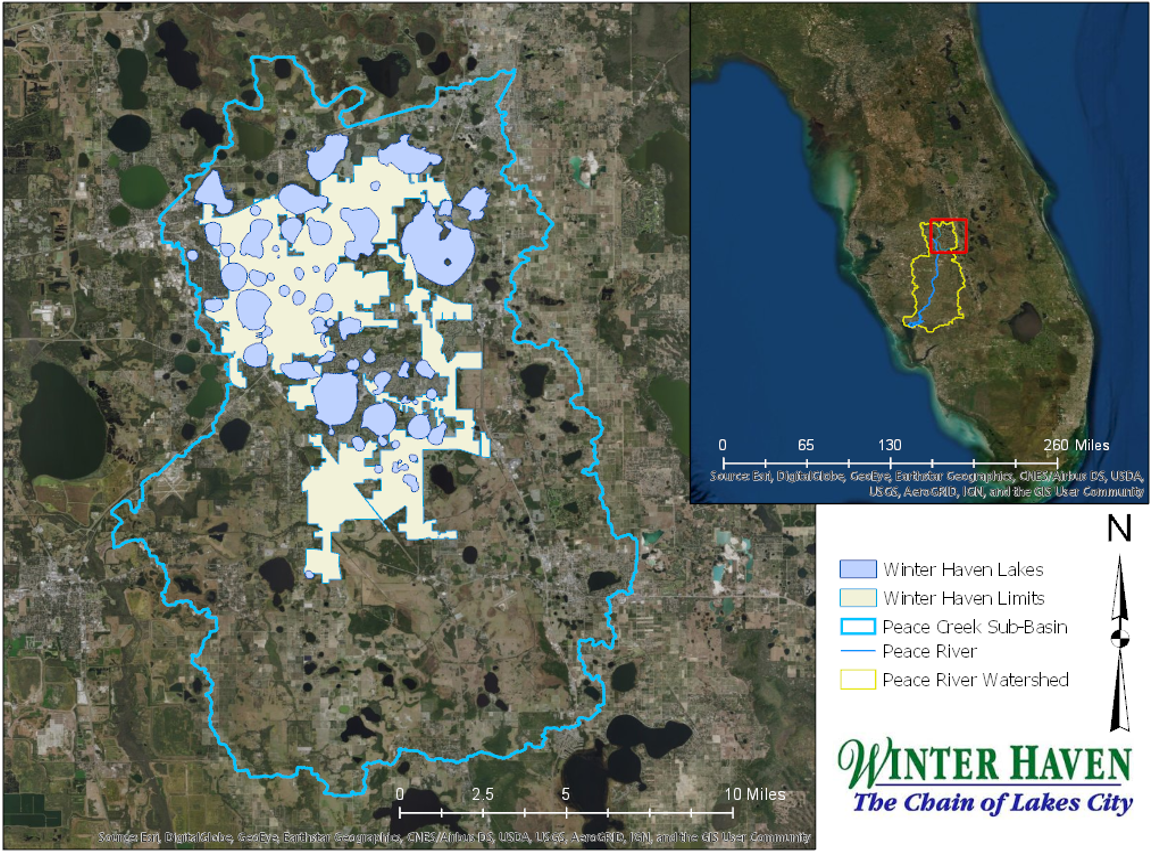
The case study below highlights GPI’s environmental and data science support for one of our visionary clients: the City of Winter Haven, FL, also known as the “Chain of Lakes City” because it has 50 lakes within or bordering its limits.
Multivariate statistical analysis examines multiple variables simultaneously to understand their relationships and interactions. This method helps identify patterns and make informed decisions based on complex data sets.
GPIs commitment to the One Water approach is demonstrated through our work with the City of Winter Haven, FL. Tasked with supporting the City’s One Water Master Plan, working as a subconsultant to Black & Veatch Corporation, GPI conducted a multivariate statistical analysis to understand the complex relationships between rainfall, groundwater pumping, and lake levels within the Upper Peace Creek Watershed. This analysis informed an optimization model that explores various water management scenarios and their impact on flood control, lake levels, aquifer recharge, water supply, and ecosystem health.
GPI’s analyses involved developing multivariate linear regression models to predict seasonal lake levels under different rainfall and groundwater pumping scenarios. Raw monthly rainfall and groundwater production data were transformed into features for use in the statistical analyses. Various rainfall decay indices were developed to mathematically weight more recent months of data, while exploring different lengths of time over which rainfall could affect lake levels (ranging from 3 to 120 months). Various production-weighted by distance indices were developed to spatially represent groundwater pumping intensity (ranging from 3 to 24 months). The results provided valuable insights into the watershed’s hydrology, highlighting the significant influence of long-term rainfall patterns and groundwater pumping on lake levels. Relevant findings included:
-
Wet season and dry season lake levels could be predicted, on average, within 0.64 feet.
-
77% of lake level fluctuations could be predicted, on average, by the multivariate models.
-
Rainfall was much more important than groundwater production in explaining lake levels.
-
Two groups of lake responses were observed, with a smaller group responding to short term changes in rainfall and groundwater pumping (i.e., a few months), and a larger group responding to multi-year trends in rainfall and pumpage.
-
Specific predictions were made for 78 unique sites for various levels of rainfall and pumpage.
Recognizing the importance of making these complex results accessible and understandable, GPI developed an interactive web application using the R computing environment and R Shiny package. GPI Data Scientist Carlos Moros created a user-friendly web application that allows water resource managers to visualize the multivariate model predictions. They can explore the potential impacts of different rainfall scenarios and groundwater pumping rates on individual lake water levels and sub-watershed basins. This interactive tool empowers decision-makers to evaluate various water management strategies and make informed choices that balance competing demands while ensuring long-term water sustainability. The application can be viewed at Multivariate Statistical Analyses of Winter Haven Lakes.
The One Water approach represents a perspective shift in how we manage this precious, limited resource. It represents a move away from fragmented, siloed practices toward a holistic, integrated approach. The One Water approach considers the entire water cycle and the interconnected needs of all users. By embracing collaboration, leveraging technology, and prioritizing sustainable solutions, GPI is helping communities like Winter Haven navigate the challenges of water management in a changing world and secure a water-resilient future for their current and future residents.
Case Study: South Hills Council of Governments (SHACOG) Flood Study
The South Hills area is a part of the greater Pittsburgh area consisting of 13 municipalities that have long experienced flooding problems. U.S. Army Corps of Engineers records of flood concerns for the area date back to the 1940s, and in the 1990s, flooding had become so bad in what used to be the neighborhood of Ansonia Place that the federal government bought out 25 homes. However, development in South Hills continued, and flooding has become far worse.
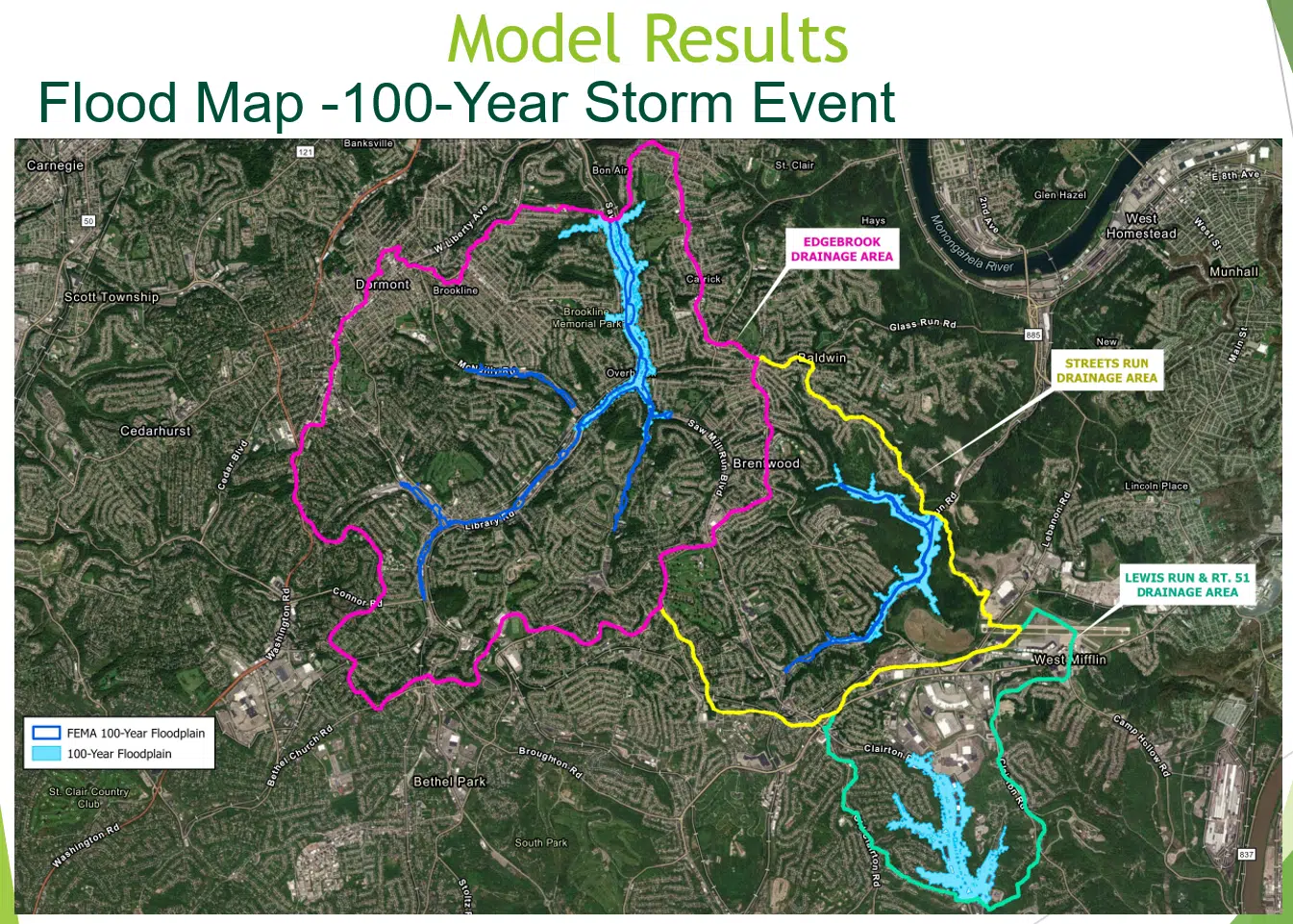
Like most of Pittsburgh, this area is connected to the steel industry. Between 1913 and the 1960s, a colossal slag mountain over five stories high was built in West Mifflin from the waste products of steel making. It is estimated that 70 million tons of slag from steel mills in the Mon Valley was dumped on a 410-acre site. This slag would glow in the dark and residents would watch the red-hot molten slag being dumped, and it would flow down the mountain like molten lava. In the 1970s, steel was still a central component of the greater Pittsburgh area economy, and the U.S. Steel Corp. made the decision to recover a large portion of the slag. It developed an 87-acre portion of the site that became the Century III Mall. Other portions of the pile of slag were transformed into shopping complexes. Water can still flow over and infiltrate these areas and carry remaining contaminants downstream. Any flood mitigation strategies must consider the slag residue.
An integrated 1D-2D model ensures the seamless transition back and forth between 1D and 2D modeling. Essentially, the integration dynamically links minor/major system components, where the 1D component represents the minor system (i.e. utility holes, inlets, pipes, culverts) and the 2D component represents the major system (i.e. overland surface, roads).
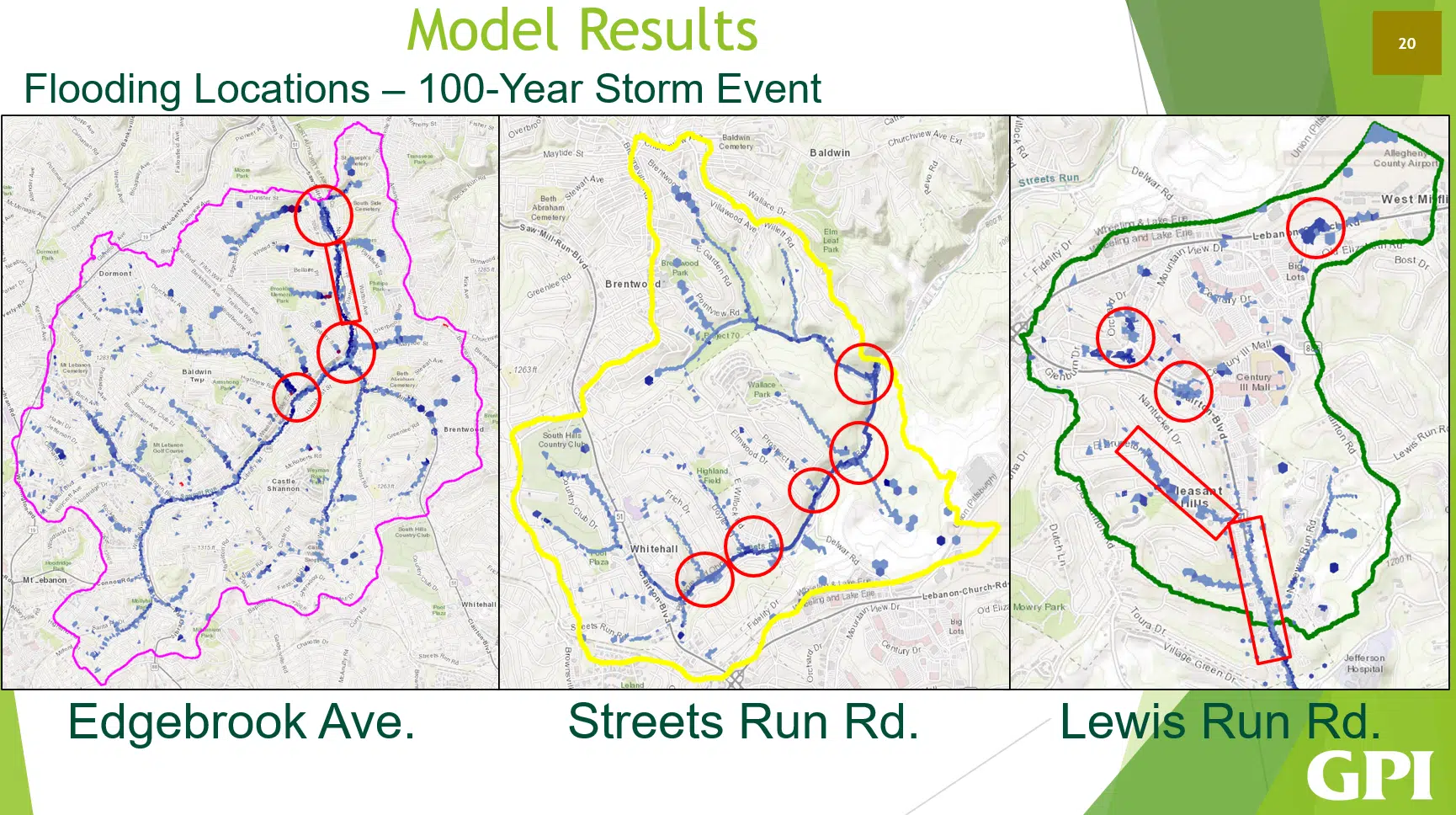
GPI was hired by the South Hills Area Councils of Governments (SHACOG) to conduct a multi-municipality flood study to identify existing flooding areas, investigate the causes, and develop alternative strategies for correcting the conditions and mitigating the impacts. Flooding in the area has been exasperated by the addition of hard, impervious cover where there previously was greenspace; changes in rainfall patterns (intensities and duration); remnants of hurricanes, which have become stronger and more frequent; lack of adequately sized stormwater pipes; reduction in pipe capacity due to debris build up resulting in conveyance system backing up; reduced capacity at inlets resulting in higher maintenance needs; and the hill and valley terrains in and around the study areas that create low spots (aka bathtubs and bowls). Additionally, increased traffic volumes on critical transportation corridors have amplified public concerns and the need to mitigate flooding issues.
GPI is guiding SHACOG in establishing an integrated stormwater management and control system. An integrated 1D-2D PCSWMM model using calibrated radar rainfall data at 15-minute intervals was used to analyze the flooding issues using the minor (underground conveyance sewer system) and major (overland/street flows, swales, etc.) system approach. Analysis results of the existing storm sewer system showed severe capacity limitations for the 2-year, 24-hour storm. GPI identified the following potential remediation options and stormwater control measures: addition and upsizing of conveyance pipes and culverts, Subsurface Detention Storages (SDS), relief interceptor piping, surface stormwater basins, porous / permeable pavement, and overall reduction of imperviousness where possible.
Resource integration and resilience have also been a key part of the SHACOG project. The area is large and requires knowledge of current storm and sewer water utilities, and practices that affect an area upstream can have major effects on areas downstream. The slag mountain history of the area also informs decisions on new and improved storage solutions. And the limited green space in the area required innovative ideas for water routing and storage. Due to the site constraints, GPI recommended the selection and implementation of a combination of diffuse and concentrated mitigation options to address the increased volume of stormwater runoff from developed areas. The diffuse methods would entail a larger number of smaller stormwater control measures (SCMs) situated throughout the watershed that will sum to meaningful improvements. The smaller number of concentrated methods would manage collective runoff from a few larger areas.
The SHACOG Flood Study aligns with the One Water concept, emphasizing the interconnectedness of upstream and downstream factors, ensuring a resilient and sustainable approach to flood management.
What can I do to make a difference?
Keep the One Water principle in mind—that all water has value. Consider ways you can reuse water on your property (e.g., capture rainwater runoff for irrigation). Be responsible with environmental impacts related to water. Bottled water is an environmental scourge due to impacts to the location the water is withdrawn from, as well as the carbon footprint of getting the water to you—not to mention the introduction of more plastic into the environment and our bodies. We recommend drinking tap water directly or filtering it to remove disinfectant residuals, in order to minimize environmental impacts and maximize personal health. Finally, consider landscaping with plants appropriate to your region that can be sustained with very little supplemental water. As an example of why sustainable landscaping is needed, we have water restrictions in Florida due to limited supplies of clean, fresh groundwater, yet nearly half the potable water in Florida is used to irrigate lawns.
About the Authors
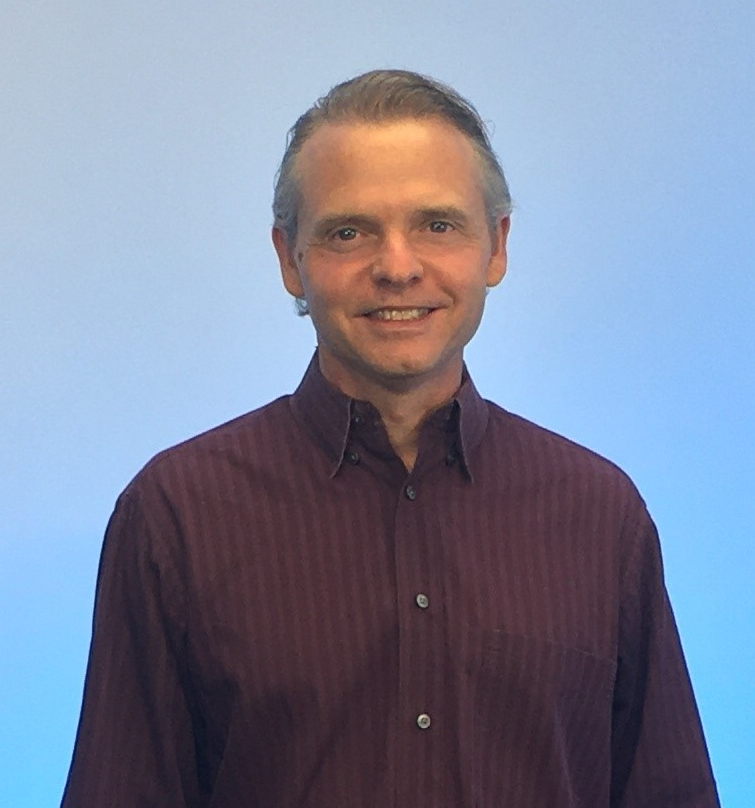
Dan Schmutz
Dan Schmutz is a Vice President / Chief Environmental Scientist for GPI’s Orlando office. He has 30 years of experience developing and applying ecological and hydrologic assessments, GIS, and data science solutions for addressing questions of interest to water resource managers. He earned a Master of Science degree in Zoology from the University of South Florida in 1997, and he is the Immediate Past President of the Florida Lake Management Society.

Ifeanyi Odigboh
Ifeanyi Odigboh is an Assistant Vice President / Director of Operations for GPI’s Pittsburgh Office. He manages operations and provides technical oversight, management, support of water resources projects and construction administration and inspection services. He has over 25 years of comprehensive technical experience in planning, design, H&H modeling and analysis, regulatory compliance / permitting and quality management. Furthermore, he is a certified floodplain manager and a certified professional in erosion and sediment control.